No items found.
Free Webinar · May 7 · How to Get (and Keep) More Patients as a Practitioner →
Save Your Spot


Table of Contents

Experience Better Practice Management Today!
Starting at $28.05/month
No Credit Card Required
Experience Better Practice Management Today!
Starting at $30/month
No Credit Card Required
Most clinics focus on treating whoever walks through the door. You assess, treat, document, and move on. That works when things are simple.
But over time, questions start to show up. An insurance review asks for clarification, a claim gets flagged, or a patient is unsure how to describe the care they received.
The clinics that stay out of trouble figured out a few things early:
In this blog, I’ll explain why scopes overlap, how disputes actually surface in clinics, and the practical steps you can take to protect your practice without changing how you treat patients.
This overlap is not a theoretical debate. It shows up in daily clinic operations, especially during audits, complaints, or insurance reviews, when someone outside your clinic has to interpret your care.
Chiropractors and physical therapists often work with the same types of patients. People come in with back pain, neck pain, movement restrictions, postural strain, or injuries that need rehabilitation. From a patient’s point of view, they are looking for relief and better function, not a distinction between professions.
Because both professions address musculoskeletal conditions and movement-related problems, overlap in the scope of practice is unavoidable.
Both professions assess movement and guide rehabilitation. Both use manual therapy and spinal manipulation as part of care. High-velocity, low-amplitude manipulation is a clear example of where the chiropractic and physical therapy scopes of practice intersect. That similarity is often where questions begin, even when the care itself is appropriate.
In most cases, the treatment itself is not the problem. Scope boundaries are shaped by professional regulation and licensing, as well as education and licensing requirements set by governing bodies.
Groups like the American Chiropractic Association influence how chiropractic scope is defined, while physical therapy follows its own regulatory frameworks. These rules are interpreted by people who were not present during treatment and who rely entirely on documentation to understand what happened.
I have seen clinics deliver solid, appropriate care and still face scrutiny because the written record did not clearly reflect how that care fit within the licensed scope.
Also read: How to Create Personalized Chiropractic Treatment Plans
Economic competition between professions is rarely openly discussed, but it does play a role. When two professions operate in the same clinical space and offer similar services, pressure builds around who can provide what.
That pressure influences how the scope of practice is enforced, especially around services like manual therapy and spinal manipulation that are in high demand.
Scope overlap often feels theoretical until an audit, complaint, or insurance review asks for clarification. At that point, patient functional outcome measures matter less than how services were described, coded, and documented.
This is where clinic systems and operational consistency start to matter. Clear, consistent records make it easier for reviewers to understand what care was delivered and why it fits within scope. That is when overlap stops being academic and starts affecting daily clinic operations.
Scope disputes almost never start with accusations. In my experience, they usually begin with a question from someone who is trying to make sense of your records.
I once worked with a small hybrid clinic where an insurer asked why a specific manual therapy code appeared so frequently. The care itself was appropriate, and patient outcomes were solid. The issue was not what was delivered, but how the service was described in clinical notes compared to how it showed up on invoices.
Clinically, nothing was wrong. On paper, the story did not fully line up. That inconsistency was enough to trigger follow-up questions.
Related read: How to Successfully Manage a Clinic and Mobile Practice on Wheels
In another case, a clinic received a patient complaint unrelated to pain levels or results. The patient was confused about the care they received. What they read on the intake paperwork did not match how the visit was explained later.
That disconnect came from blended terminology across forms. Different words were used to describe the same service, which created uncertainty and frustration for the patient.
Audits tend to focus on language more than anything else. Certain phrases raise questions faster, not because they are unsafe, but because they blur professional boundaries.
I have seen audits triggered simply because documentation used terms that could be interpreted in multiple ways.
Marketing often creates problems long after it is written. Websites and brochures are sometimes reviewed during audits, especially when there are questions about scope.
I have seen clinics pulled into deeper reviews because marketing language promised outcomes or approaches that felt outside the licensed scope. The intent was to explain care clearly, but the phrasing worked against them.
If you want to ace your marketing: 12 Proven Chiropractic Marketing Strategies to Attract More Clients
Most scope issues catch clinics off guard, not because of poor care, but because of assumptions that seem reasonable until tested.
This is one of the most common assumptions I hear. In practice, scrutiny often comes from overlap, not overreach. When two professions work in the same clinical areas, perception matters as much as intent.
I worked with a solo mobile chiropractor who stayed well within his clinical comfort zone. A documentation review still raised questions because his service descriptions were inconsistent across records.
Here’s an interesting webinar for mobile practitioners: What Mobile Practitioners Really Need to Deliver Better Outcomes
Scope questions usually show up as billing, documentation, or communication issues first. These are clinic problems long before they become legal ones. Most clinics experience them indirectly through denied claims or requests for clarification. Over time, that friction adds up and slows everything down.
Once you understand how scope issues appear and why they catch clinics off guard, the next step is to focus on what is actually within your control. It’s the day-to-day systems that shape how your clinic is understood from the outside.
At this stage, the goal is not to rehash why wording matters, but to ensure your clinic speaks one clear language everywhere it appears.
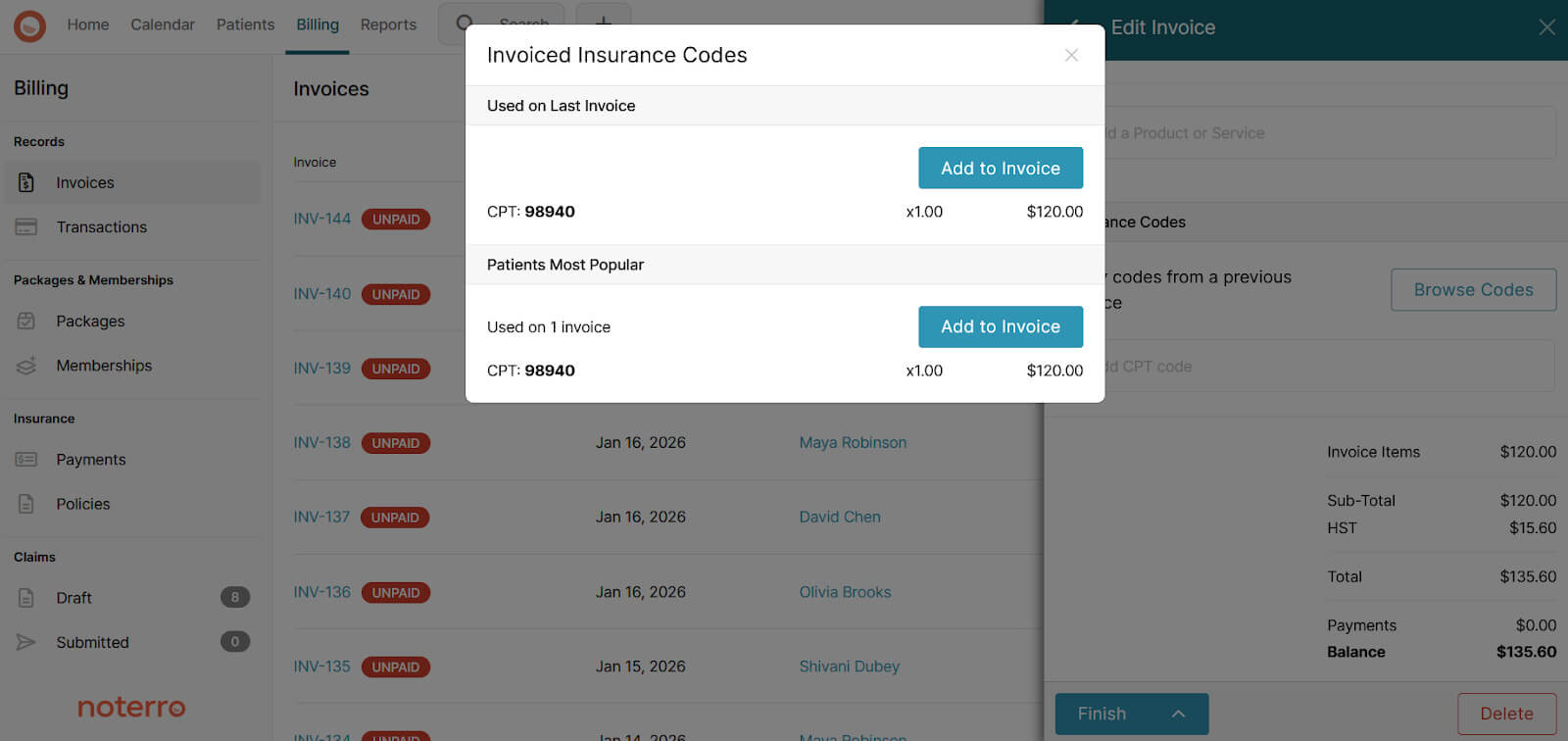
Service names, appointment types, and billing descriptions should mean the same thing no matter where someone looks. Online intake forms, schedules, invoices, and reports should all tell the same story.
Noterro helps here by giving clinics a single place to define services, appointment types, and use correct codes during billing. When the process is automated and streamlined, consistency stops being something you have to police.
At this stage, documentation is less about proving that care happened and more about showing coherence across the clinic. Someone reviewing your records later should be able to understand the intent, assessment, and rationale without having met the patient or the practitioner.
This matters even more in clinics with multiple providers or mobile teams. I have worked with clinics where every practitioner documented well, but each did it slightly differently. During an insurance review, that variation created confusion and unnecessary follow-up, even though the care itself was solid.
Noterro helps bring structure without forcing rigidity. Clinics can use shared clinical note templates and SOAP notes to set a clear baseline. Predictive charting and Snippets (shorthand phrases) reduce variation in how common findings are recorded.
For practitioners who prefer to talk through care, Noterro Scribe records voice notes during visits and converts them into structured, written SOAP notes that retain the practitioner’s voice. The result is documentation that stays consistent across the clinic without slowing anyone down.
Also read: How to Maximize Mobile Chiropractic Practice Growth with Patient Retention
Clear communication is not just for compliance. It keeps patients grounded in what care is meant to do and how progress is measured.
Care plans should stay aligned with the licensed scope and focus on realistic outcomes. Overexplaining or overpromising usually creates more confusion than confidence.
When the same language shows up in intake forms, visit summaries, and follow-up communication, patients are less likely to feel surprised or misled later. That consistency protects both the relationship and the clinic.
You do not need a legal overhaul to lower your risk. What you need is a setup that still makes sense when someone reviews your records months later without having met you or your patients.
Start by reviewing your documentation templates and intake forms regularly. Clinics evolve, but paperwork often does not. When forms no longer reflect how care is actually delivered, that gap is where questions start.
Make sure your team is using the same terminology and understands why it matters. This is not about forcing scripts or changing how care is provided. It is about describing the same service consistently everywhere it appears.
Keep service definitions simple and accurate. The more you try to cover every edge case, the harder it becomes to explain clearly during a review.
This is where systems help. Noterro brings documentation, forms, billing, and communication into one place, with shared templates and role-based permissions that help clinics stay consistent without having to constantly check everyone’s work.
Scope debates will keep shifting. That is outside your control. What you can control is how clearly your clinic documents care, describes services, and communicates intent when someone reviews your records later.
You do not need to change how you treat patients to reduce risk. You need consistency that holds up across notes, forms, and billing, especially in multidisciplinary clinics where different disciplines work side by side.
Noterro helps keep those pieces aligned without adding more work. If you want to standardize the parts that get reviewed most and spend less time cleaning things up later, you can book a demo and see how it fits into your workflow.

Tags
Ryan Barichello, Co-Founder of Noterro, is a dynamic leader with a vision for innovation and excellence in the tech industry. With both a Business and Computer Science diploma from Mohawk College, Ryan has honed his business and software development expertise.
His leadership and dedication have garnered him several prestigious awards, including the 2018 Fast 40 Hamilton issued by Hamilton Economic Development. He also received the 2015 Outstanding Small Business of the Year from the Stoney Creek Chamber of Commerce and the 2013 Hamilton Top 40 Under 40 from Business Link Media.
Beyond his professional achievements, Ryan is deeply involved in community initiatives. As a board member of Festitalia for 9 years, he actively promoted Italian culture and heritage in the community. He also has spent time volunteering as a mentor in Greater Hamilton Teaching Youth Entrepreneur Program (M.I.G.H.T.Y), nurturing the next generation of leaders.
With a keen eye for detail and a disciplined approach, Ryan tackles challenges with precision, ensuring that every project he undertakes is a resounding success. Ryan's strategic mindset and passion for entrepreneurship have been instrumental in propelling Noterro to the forefront of the industry.
Driven by a relentless pursuit of excellence, Ryan is passionate about technological innovation. His expertise in addressing complex challenges with precision, alongside his dedication to innovation, sets him apart as a leader in the technology field.


.webp)
No credit card required. Available 1-on-1 support.
.webp)
No credit card required. Available 1-on-1 support.
.webp)
.webp)


.webp)