No items found.
Free Webinar · May 7 · How to Get (and Keep) More Patients as a Practitioner →
Save Your Spot


Table of Contents

Experience Better Practice Management Today!
Starting at $28.05/month
No Credit Card Required
Experience Better Practice Management Today!
Starting at $30/month
No Credit Card Required
If you run a mobile practice, a single cancellation can disrupt more than a single visit. I have seen it affect revenue, route planning, and the flow of the entire day. Many patients still mean to come back, but busy schedules and delayed rebooking often get in the way.
In my experience, stronger re-engagement usually comes down to four things:
In this blog, I’ll walk through strategies that can help mobile practitioners follow up more effectively and bring patients back before short gaps turn into longer ones.
The best re-engagement efforts usually come down to a few practical habits you can repeat. Here are six practical strategies to help mobile practitioners re-engage patients before short gaps turn into longer ones.
Not all patients who have not booked in a while, did not return after a session, or recently cancelled should be approached in the same way. That is often where follow-up starts to lose its effect.
A better approach is to group patients before you reach out. Start by looking at:
This helps you send more targeted follow-ups instead of using the same message for everyone. A patient who cancelled last week is not in the same position as someone who has not returned for months. A patient in repeat care also needs a different message than someone who books only from time to time.
With Noterro, a clinic management solution, practitioners can use the Patients Without Appointments report to see which patients have no future bookings and when their last booking was.
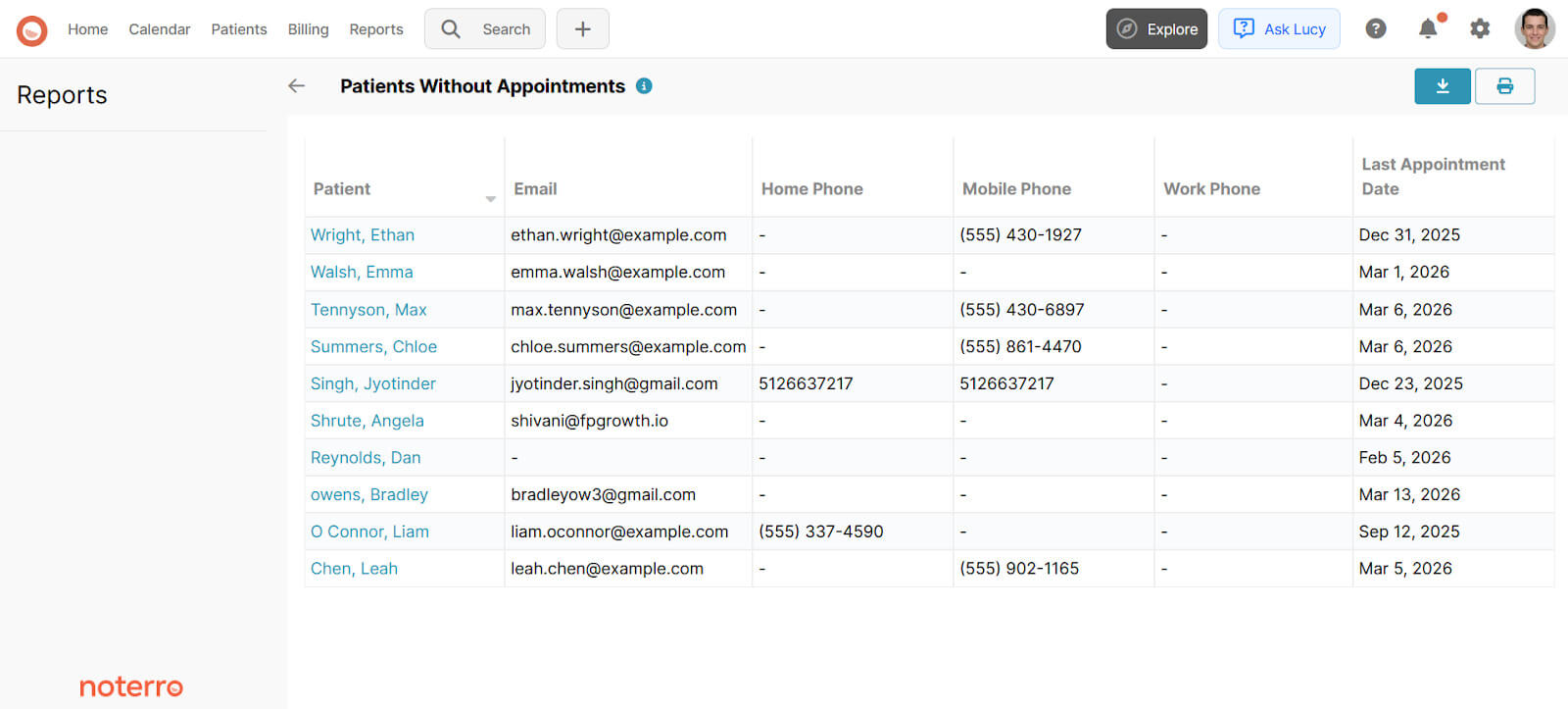
It makes it easier to prioritize who needs follow-up first and decide which re-engagement approach makes the most sense.
Pro Tip:
You can organize them in Excel or Google Sheets and group them by the details that matter most, such as patient type, time since the last appointment, and the follow-up method you want to use. That could be a treatment follow-up notification in Noterro, an email campaign via Noterro and Mailchimp integration, or a direct call for a more proactive and personalized approach.

Timing matters because the patient’s original reason for booking is still fresh right after a cancellation. If too much time passes, that short disruption can turn into a much longer gap. The patient may still mean to return, but the urgency fades, and the appointment slips down the list.
A quick, helpful message can prevent that from happening. This matters even more for mobile practitioners because late changes affect more than one slot. They can affect route efficiency, travel time, and how much of the day you can still use well.
A follow-up at this stage should feel prompt, helpful, easy to reply to, and respectful in tone. Something short is often enough if it is sent at the right time.
Mobile practitioners should look at both which patients need follow-up and where they are located. That is what makes this part different from fixed-location follow-up. A patient often becomes easier to bring back when you are already planning visits in that area.
In practical terms, that can mean:
This is one of those small shifts that can make re-engagement work harder. It stops being only a retention task and starts helping you build a smarter schedule, too.
Pro Tip:
When a gap opens up in a certain area, update your service area in the GO Settings first. Noterro can then show you the patients inside that area on a map, so you can quickly see who nearby may be a good fit to contact and fill that opening.

You might find this helpful: How to Manage Mobile Clients, Charts, and Scheduling with Noterro GO
Many patients do not return because rebooking feels like another task they will deal with later. That is why reducing friction matters so much.
A good re-engagement message should not only remind the patient to return, but also encourage them to do so. It should make the next step easy enough to take right away.
That can be as simple as including:
The fewer steps the patient has to take, the better.
With Noterro, patients can book online and manage appointments through the clinic-branded web app. This gives them a much easier way to return without the extra back-and-forth.
For mobile practitioners, that matters because a simple rebooking path can help fill available time before it slips away.
Related Read: Why Your Clinic Needs a Branded Mobile App
Generic re-engagement messages often get ignored because they do not feel connected to the patient’s actual care journey. Messages work better when they reflect real aspects of the appointment history and the reason for follow-up.
That can include:
That kind of personalization helps the message feel more relevant. Instead of reading like a generic reminder, it reads like a follow-up tied to the patient’s care.
A simple message becomes stronger when it answers one quiet question in the patient’s mind: why should I come back now?
Tone matters just as much as timing. Patients are more likely to respond when the message feels helpful and respectful. If it sounds like you are only trying to fill a slot, it can create distance. If it feels like a thoughtful check-in, it is much easier for the patient to respond well.
That is why the message SHOULD feel supportive, calm, respectful, and patient-focused.
For example. “Hi Sarah, I wanted to check in since it has been a little while since your last appointment. If you have been meaning to book again, I’d be happy to help you find a time that works.”
It SHOULD NOT feel like pressure, guilt, urgency for your schedule, or a pushy sales nudge.
For example, “Hi Sarah, I noticed you still do not have your next appointment booked. I have a few openings this week if you want to get something scheduled.”
This matters across disciplines because trust often plays a major role in whether patients come back.
Many patients stop booking for practical reasons. Busy schedules, missed follow-ups, and delayed rebooking often create longer care gaps than intended.
That is why mobile practitioners need a re-engagement process that is timely, relevant, and easy to act on. In most cases, that means identifying the right patients, reducing booking friction, sending more relevant follow-ups, and using reminders before the gap grows.
Tools like Noterro can support that process by making follow-ups and rebooking easier to manage, while Noterro GO helps mobile practitioners stay more organized on the road.

Tags
Ryan Barichello, Co-Founder of Noterro, is a dynamic leader with a vision for innovation and excellence in the tech industry. With both a Business and Computer Science diploma from Mohawk College, Ryan has honed his business and software development expertise.
His leadership and dedication have garnered him several prestigious awards, including the 2018 Fast 40 Hamilton issued by Hamilton Economic Development. He also received the 2015 Outstanding Small Business of the Year from the Stoney Creek Chamber of Commerce and the 2013 Hamilton Top 40 Under 40 from Business Link Media.
Beyond his professional achievements, Ryan is deeply involved in community initiatives. As a board member of Festitalia for 9 years, he actively promoted Italian culture and heritage in the community. He also has spent time volunteering as a mentor in Greater Hamilton Teaching Youth Entrepreneur Program (M.I.G.H.T.Y), nurturing the next generation of leaders.
With a keen eye for detail and a disciplined approach, Ryan tackles challenges with precision, ensuring that every project he undertakes is a resounding success. Ryan's strategic mindset and passion for entrepreneurship have been instrumental in propelling Noterro to the forefront of the industry.
Driven by a relentless pursuit of excellence, Ryan is passionate about technological innovation. His expertise in addressing complex challenges with precision, alongside his dedication to innovation, sets him apart as a leader in the technology field.
.webp)
No credit card required. Available 1-on-1 support.
.webp)
No credit card required. Available 1-on-1 support.
.webp)
.webp)


.webp)