No items found.
Free Webinar · May 7 · How to Get (and Keep) More Patients as a Practitioner →
Save Your Spot

Table of Contents

Experience Better Practice Management Today!
Starting at $28.05/month
No Credit Card Required
Experience Better Practice Management Today!
Starting at $30/month
No Credit Card Required
Most clinics don’t struggle because they lack patients; they struggle because financial decisions are made too late.
Budgeting matters because clinic income is uneven, expenses shift with volume, and minor issues compound quietly over time.
Heading into 2026, this becomes harder to ignore as costs rise and patient behaviour continues to change. Without a clear budget, it’s difficult to plan growth, protect your time, or know what the clinic can realistically support.
In this blog, I’ll cover how to:
Let’s get started.
Clinic budgeting breaks down when it’s treated like personal budgeting. Personal income is usually predictable. Clinic income rarely is. Some months fill up fast, while others slow down without much warning. Seasonal demand plays a role too, especially around holidays, summer months, and school schedules, and that uneven rhythm directly affects cash flow.
Expenses follow a similar pattern. Some stay stable, like rent, software costs, and insurance. Others shift with volume and activity:
Most budgets also ignore everyday realities that have a real financial impact:
Checking your bank balance only shows what’s left at the moment. It doesn’t explain why a slow week feels stressful, highlight outstanding balances, or support revenue forecasting. Clinic budgeting works when it plans for change instead of assuming stability.
Once you accept that clinic finances are inherently uneven, budgeting becomes less about control and more about awareness. The tips below help you see your real numbers clearly, plan around variability, and make decisions earlier rather than react later.
Before planning ahead, you need to understand what actually happened over the last year. Not what you hoped would happen or what one strong month suggested. The full picture matters.
Start by reviewing the last twelve months of income and payouts. Focus on what was actually received, not just what was billed. That difference alone explains much of the cash flow stress.
Once you do that, separate your expenses into two simple categories. Fixed expenses that stay fairly consistent, and variable expenses that change with client volume. Patterns usually show up quickly once you do this.
You’ll often notice:
This is also where blind spots surface. Missed invoices, delayed payments, and small recurring charges that never felt urgent but added up.
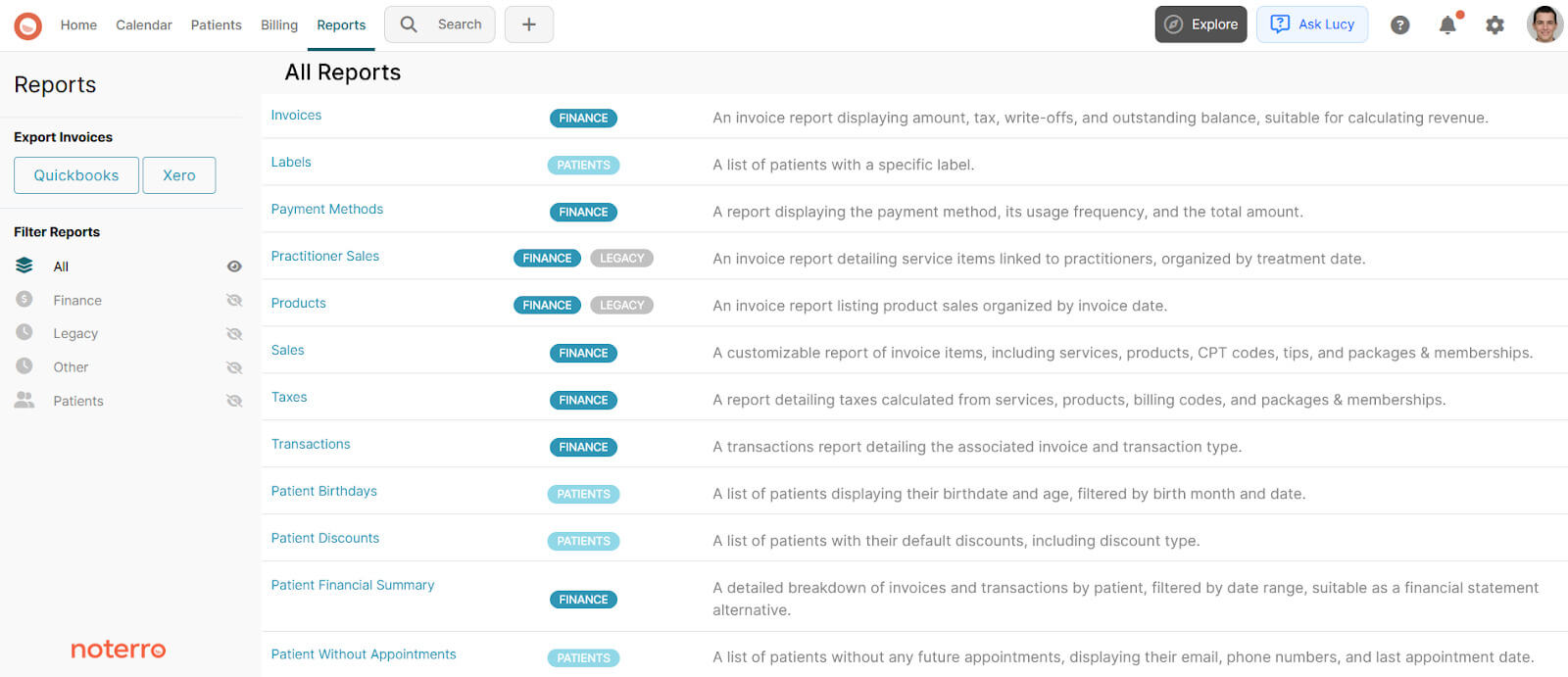
When billing, payments, and invoices live in one place, this process becomes far easier. In a clinic management software like Noterro, financial reports show income, outstanding balances, and payment activity together, so you’re not stitching numbers across tools.
When a deeper accounting review is needed, exporting data to QuickBooks or Xero keeps things consistent. The goal here isn’t judgment. It’s visibility.
Related read: 10 Best Patient Management Software For Small Clinics
Start by setting clear revenue targets based on how much you can realistically work, not how much you wish you could earn. Look at your average weekly appointments from the past year and decide what a sustainable workload looks like for you in 2026. Use that number to calculate revenue, instead of increasing hours by default.
Next, separate personal income from clinic growth on paper. Write down the minimum monthly amount the clinic needs to pay you consistently. Then decide what portion of the remaining revenue can go toward growth, such as hiring, equipment, or savings. Treat these as two different goals so one does not quietly absorb the other.
Plan explicitly for time off and slower months. Identify which months tend to dip and budget lower revenue for those periods. Build your goals around that reality so slower weeks don’t feel like failure.
Finally, base every goal on actual revenue reports, not estimates. When goals are tied to real numbers, decisions stay grounded and easier to adjust.
You might also like to read: How Is Your Personal Social Media Shaping Your Professional Image?
Some costs should never feel surprising. Rent, utilities, and clinic space expenses form the base. Insurance, licensing, and professional fees need to be accounted for consistently.
If you work with staff or contractors, include those costs honestly. Partial coverage, admin hours, and flexibility all carry a price, even when they feel small individually.
Clinic management software and other tools that support daily operations follow closely. When scheduling, documentation, billing, and payments are handled on a single platform, software costs are easier to predict. Fewer disconnected tools usually mean fewer unexpected charges appearing later.
Variable expenses are where many clinic budgets quietly fall apart, not because they are unexpected, but because they are rarely planned for properly. These costs change month to month and often show up all at once. Common examples include:
These expenses aren’t mistakes or signs of poor planning. They’re a normal part of running a clinic. Budgeting for them upfront protects cash flow and reduces financial stress. Tracking them over time also helps you see cost percentages clearly, which makes future budgeting decisions easier and more grounded.
Here’s another useful read: How to Grow a Practice When You’re Not a Natural Networker
Unpredictable income is part of running a clinic and doesn’t say anything about the quality of your care or the health of your practice. The real challenge usually comes from planning around best-case scenarios, like full schedules, perfect attendance, or immediate payments, which rarely hold consistently.
Planning for variability means building flexibility into your budget so normal disruptions don’t create financial stress. That includes accounting for cancellations, no-shows, and delayed payments rather than treating them as exceptions.
A few practical steps help stabilize cash flow over time:
Recurring appointments, deposits, packages, and memberships can support a steadier income when set up intentionally. In Noterro, these tools help smooth cash flow and make budgeting easier as the year progresses.
Also read: 9 Strategies for Choosing The Right Clinic Management Software
Annual budgets help set direction, but monthly budgets show how the clinic is actually performing. Breaking yearly goals into monthly targets makes it easier to plan for seasonal slowdowns rather than react to them.
Focus on tracking real numbers rather than estimates. Look at actual income received, actual expenses paid, and current outstanding balances. A budget needs some flexibility, but once it’s ignored, it loses its usefulness.
When billing and payment information is easy to review, monthly budget check-ins stay short and consistent. Brief, regular reviews tend to work better than long sessions that are easy to postpone or avoid altogether.
I’ve found that budgeting only works when it’s treated as an ongoing check-in, not a one-time setup. The clinics that feel the least stressed are usually the ones that review their numbers monthly and catch issues early, before they turn into real pressure. That might be rising outstanding balances, subtle shifts in revenue, or expenses slowly drifting above plan.
Making adjustments is much easier when decisions are based on patterns rather than gut feeling. Clear, consistent reports help you see what’s changing and decide whether pricing, spending, or scheduling needs to shift.
With Noterro, revenue trends, unpaid invoices, and client activity are visible in one place, making it easier to spot issues early and adjust before they affect the day-to-day running of the clinic.
When I see clinics working hard but still feeling stretched, it’s usually because profit and owner pay are treated as leftovers. The Profit First method changes that by deciding where money goes before it gets spent.
I’ve seen it work well because it forces clear boundaries. You allocate incoming revenue into buckets like owner pay, profit, taxes, and operating expenses, then run the clinic within what’s left.
The exact percentages matter less than the habit. Paying yourself first, setting aside money for taxes, and limiting expenses to real cash flow help clinics avoid overspending while still growing in a controlled way.
Bonus read: Why Soft Skills Are Essential for Client Retention in Allied Health
Most budgeting problems don’t come from a lack of effort. They come from missing information, delayed decisions, or relying on signals that don’t tell the full story. These are the issues I see most often when clinics feel financially stressed, even when revenue looks fine.
Many clinics budget for rent and software, but forget how much variable expenses shift with volume. Payment processing fees, supplies, admin time, and equipment use grow quietly as bookings increase. If these are not tracked monthly, cash flow feels tighter even when revenue is up.
Taxes often get treated as a future problem. That usually works until it doesn’t. Setting aside money regularly, even roughly, reduces stress and prevents last-minute decisions that hurt the clinic or your personal income.
When income fluctuates, paying yourself becomes optional in practice. Over time, that blurs the picture of whether the clinic is actually healthy. A consistent personal draw, even a modest one, gives you a clearer signal about what the practice can truly support.
A healthy-looking balance can hide unpaid invoices or upcoming expenses. Without looking at outstanding balances and recent revenue trends, decisions get delayed or rushed.
Adding hours, hiring help, or investing in equipment feels like progress, but without understanding monthly cash flow, these moves often increase pressure rather than relieve it.
Minor issues are easier to fix early. Rising unpaid invoices, creeping costs, or slowing months usually show up in reports before they feel serious. The longer they’re ignored, the harder they are to unwind.
Most budgeting problems don’t come from poor discipline or lack of effort. They stem from a lack of visibility and delayed decisions. Once those two things improve, budgeting starts to feel supportive instead of restrictive.
Budgeting works best when it gives you room to think instead of adding pressure. Planning ahead reduces financial stress because fewer things come as surprises, and decisions don’t feel rushed. When you can see how money actually moves through your clinic, time off feels intentional instead of risky, and slow weeks stop feeling like personal failure.
You don’t need a perfect setup. You need something realistic that reflects how your clinic actually runs day to day.
When scheduling, billing, payments, and reporting are connected through a trusted platform like Noterro, reviewing your numbers becomes part of running the practice, not a separate chore.
That kind of clarity makes decisions easier. And when decisions are easier, your clinic starts supporting your life instead of competing with it as you move into 2026.

Tags
Nick Gabriele, Director, Noterro, has been leading the company to greater heights since May 2012. With his vision and 10+ years of expertise, Noterro has become a leading practice management software that offers users an innovative platform for storing notes, tracking appointments, and managing their practice.
Noterro was born out of the need to create a more efficient way to manage paper charts at Ontario College of Health and Technology, which Nick owned.
For nine years, he has performed Independent Medical Evaluations, which allowed him to sharpen his skills in assessing and providing solutions to various health-related issues. With a strong background in rehabilitation settings, including Chiropractic, Physiotherapy, and Massage Therapy, Nick has also garnered a wealth of experience in his field.
Furthermore, Nick has a knack for passion and proficiency in education that has also led him to work in private education for over 20 years. This invaluable experience has enabled him to develop a deeper understanding of how to deliver top-notch training and support to individuals and organizations alike.
In addition to his professional achievements, Nick is an active speaker and has participated in several webinars and podcasts on topics related to electronic record-keeping and practice management. He also has written a plethora of leadership articles on tech topics, including "Charting in the electronic age," "How to Leverage Practice Management Software." His work has been featured in top industry publications, such as Hamilton News. Nick’s insights also have been cited in notable Podcasts like Business Blueprint and Practiciology.
.webp)
No credit card required. Available 1-on-1 support.
.webp)
No credit card required. Available 1-on-1 support.
.webp)
.webp)




.webp)